There’s a particular moment in spring when the woods seem to change almost overnight.
One week they’re bare and muted, with last year’s leaves covering the woodland floor. The next, they’re carpeted with bluebells, as if the colour has slowly been turned up across the entire landscape. It is one of the most beautiful transformations in the British countryside, but it doesn’t always make for straightforward photography.
A woodland full of bluebells is an impressive sight in person. Translating that feeling into a photograph is much harder. The challenge is not simply capturing the flowers themselves, but finding a composition that explains why the place feels so special.
After photographing bluebell woods over several years, I’ve learned that the best images rarely come from simply pointing a camera at the largest patch of flowers. They come from understanding the woodland, paying attention to the light, and looking for the smaller details that make each place unique.
This isn’t a set of rules, nor is it the only way to photograph bluebells. It is simply the approach that has developed through my own experience.
Before I leave home
The first challenge is finding the right woodland.
Bluebells favour ancient woodland, quiet lanes, and the edges of fields, although they can sometimes appear in unexpected places. Some locations are famous for their displays, but I’ve often found that smaller, quieter woods can be just as rewarding. A well-known location may provide an impressive carpet of flowers, but a less visited woodland often gives more freedom to explore and look for intimate compositions.
A little planning goes a long way. I usually spend time looking at maps, checking possible locations and reading about access before I visit. I’m not trying to find a photograph someone else has already taken. Instead, I want to understand the landscape: where the paths run, how the woodland is structured, and whether there are interesting features that might help create a stronger composition.
Timing matters too.
In the UK, bluebells usually reach their peak between mid-April and mid-May, although the exact timing changes every year depending on the weather. Arrive too early and the flowers may be sparse. Leave it too late and the display can quickly begin to fade.
Even when the timing is right, I never assume the woodland will look exactly as I imagined. Some years the flowers are stronger than others. Storms can flatten sections of the display, dry weather can affect the colour, and the same woodland can feel completely different from one visit to the next.
That uncertainty is part of what makes returning worthwhile.
Choosing the right conditions
The time of day and weather make a huge difference when photographing bluebells.
The first time I photographed them, I imagined bright sunshine would create the most beautiful conditions. In reality, woodland is often much harder to photograph in strong light. Sunlight filtering through trees can create deep shadows and bright highlights, making it difficult to capture the calm, even atmosphere that makes bluebell woods so appealing.
I’ve found softer conditions are often much more forgiving.
Overcast days can work beautifully because the light becomes more even, allowing the colours of the flowers, trees and woodland floor to appear naturally. Without strong contrast pulling attention away, it becomes easier to notice smaller details and quieter compositions.
Early mornings are often my favourite time to visit. The woodland is usually at its most peaceful, with fewer people and softer light filtering through the trees. On one visit, I arrived before sunrise and found the flowers still covered in dew. As the first light reached the woodland floor, the droplets caught the glow and the bluebells looked almost like tiny pieces of coloured glass scattered among the leaves.
Rain can also transform the mood of a woodland. Wet leaves become richer in colour, droplets add texture, and the atmosphere feels much more immersive. The main challenge is movement. Even a gentle breeze can make it difficult to keep flowers sharp, especially when photographing close details.
Rather than seeing that as a problem, I’ve learned to work with it. Sometimes the movement itself becomes part of the photograph.
Looking beyond the carpet of blue
The obvious photograph in a bluebell wood is often the wide view.
A huge carpet of flowers stretching into the distance is impressive, but it can also be surprisingly difficult to photograph well. Without something to guide the viewer through the frame, the image can quickly become a collection of blue flowers without a clear focus.
When I arrive, I usually take a few of those obvious photographs first.
Partly because they are often worthwhile.
Partly because popular locations can become busy, and I know the quiet moments may not last forever.
After that, I slow down.
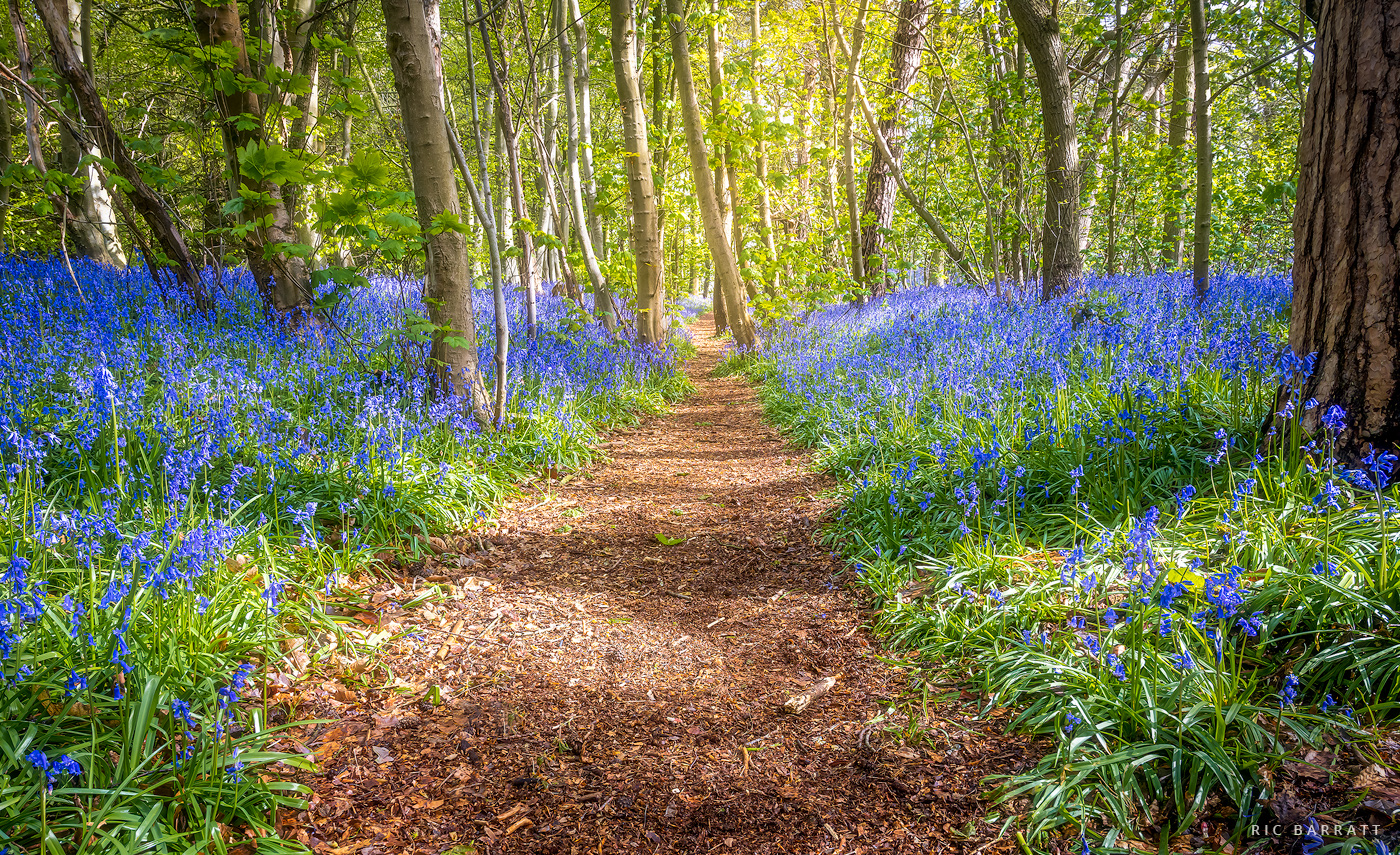
I start looking for the details that make the woodland feel like a place rather than just a display of flowers. A winding path disappearing between the trees. A fallen branch covered in moss. A gap in the flowers where the woodland floor is still visible. Layers of trees creating depth behind the bluebells.
These small elements often provide the structure that a photograph needs.
The flowers are the subject, but the woodland is what gives them context.
Finding the right perspective
One of the biggest changes in my approach has been learning to photograph bluebells from different heights.
Standing upright and looking down often produces a familiar view, but lowering the camera changes the relationship completely. Shooting closer to flower level places the viewer among the bluebells rather than simply showing them from above.
A wide-angle lens can help create a sense of immersion, bringing together the flowers in the foreground with the trees and woodland beyond. It gives the impression of being surrounded by the landscape rather than looking at it from a distance.
At other times, I prefer a more intimate approach.
A macro or telephoto lens can isolate individual flowers, revealing details that are easy to miss when surrounded by the larger scene. The curve of a stem, droplets resting on petals, or a single flower catching a beam of light can all create photographs that feel very different from the traditional woodland view.
Neither approach is better than the other. They simply tell different stories.
Working with woodland light
Light is often the deciding factor in whether a bluebell photograph works.
Woodland light changes constantly. A scene that looks ordinary one moment can completely transform when the sun moves through the trees or clouds briefly soften the contrast.
I often find myself waiting rather than constantly moving. A composition that feels unremarkable in flat light may suddenly come alive when a patch of sunlight reaches the flowers or illuminates the background trees.
Patience is especially important in spring woodland because the best moments can be brief.
The challenge is not always finding a beautiful place. Bluebell woods are beautiful almost everywhere. The challenge is waiting for the moment when the light reveals something more.
Respecting the woodland
There is also an important responsibility that comes with photographing bluebells.
These displays can take many years to develop, and the plants are fragile. A photograph can often be improved by stepping into the flowers, but that small action can damage the woodland for years to come.
I always try to stay on established paths and avoid trampling areas simply to create a slightly better composition. The best photographs are not worth harming the place that made them possible.
Part of loving these landscapes is helping to preserve them.
My favourite lesson
If there is one thing photographing bluebell woods has taught me, it is that the most impressive view is not always the strongest photograph.
A woodland covered in bluebells is already beautiful. The camera does not need to exaggerate it. The challenge is to slow down enough to notice the smaller moments that explain why the place feels special.
Sometimes that might be a single flower catching the light. Sometimes it might be a path disappearing between the trees. Sometimes it might simply be the atmosphere of standing quietly among thousands of flowers while the woodland wakes around you.
Bluebell season lasts only a few weeks each year, which is perhaps part of what makes it so memorable.
For a brief moment, familiar woodland becomes somewhere completely different.
The photographs I value most are not just records of that transformation. They are reminders of the experience of being there.