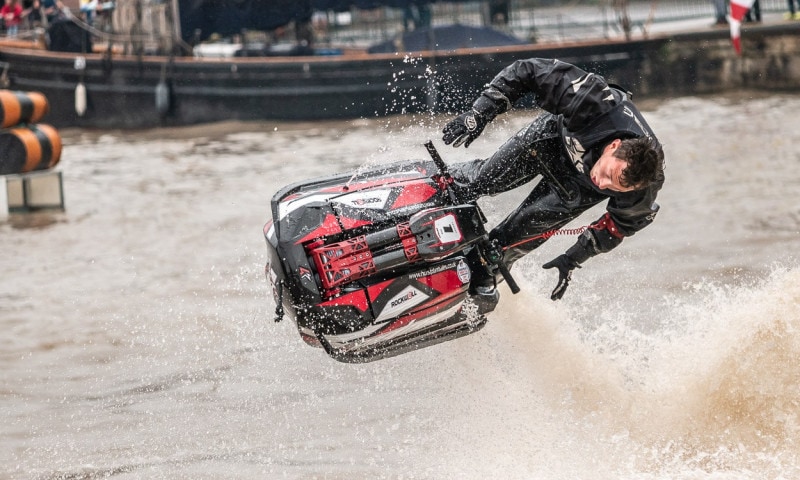
Whether you’re cheering at a high-profile sporting fixture or just watching your local team, capturing the action with your camera can be incredibly rewarding. Fast-moving subjects are challenging, but with the right settings, techniques, and a little preparation, you can take photos that really convey the speed, energy, and excitement of the event.
Here are my top tips for sports and action photography.
1. Use shutter priority mode (S-mode)
The key to freezing fast-moving subjects is controlling your shutter speed. Shutter priority mode allows you to set the speed while your camera handles the rest. This is essential for capturing athletes in motion without blur.
2. Set a fast shutter speed
Start with 1/500 of a second and adjust as needed. Faster movement—or using a telephoto lens—may require 1/1000 or higher. As your shutter speed increases, your camera will automatically adjust the aperture to maintain proper exposure. This often gives a pleasing shallow depth of field that isolates your subject from the background.
3. Adjust ISO for low light
If you’re shooting indoors or at night, there might not be enough light to capture action without increasing ISO. Cameras set to auto ISO will adjust for you, but higher ISO can introduce noise. You may not notice it on a small screen, but it can show up when printing or zooming in.
4. Use burst mode
Burst mode allows you to take multiple photos in rapid succession. This increases the chances of capturing the perfect moment, whether it’s a goal, a jump, or a critical play. Once back at your computer, you can select the best shots and discard the rest.
5. Choose a fast memory card
Burst mode can fill your camera’s memory buffer quickly. Using a fast memory card compatible with your camera ensures images are saved quickly, preventing the buffer from filling up and missing shots.
6. Consider shooting JPEG for speed
RAW files are great for editing, but they are large and can slow down burst shooting. Temporarily switching to JPEG or smaller image sizes can help capture more frames in a sequence. Just remember, this comes at the expense of some image quality.
7. Optimise your autofocus
Single-point autofocus can be faster and more predictable than multi-point. Continuous focus mode is helpful for tracking moving subjects, but you may need practice to keep your subject in focus. Advanced cameras can track subjects automatically, so check your manual for your camera’s capabilities.
8. Use manual focus when appropriate
If you can predict the subject’s path, manual focus can help. For example, in horse show jumping, focus on the fence and then switch to manual before the jump. You can then concentrate on timing the shutter without worrying about refocusing.
9. Bring a telephoto lens
A telephoto lens is essential unless you can get very close to the action. For heavier lenses, a tripod or monopod can help reduce fatigue and keep shots steady.
10. Extra tips
- Practice with local events before attending big games.
- Anticipate the action—study players’ movements or routines.
- Always check your camera settings before the event, as light and conditions can change quickly.
EDITING SPORTS AND ACTION PHOTOGRAPHS
Once you’ve captured your images, editing can help bring out the energy and excitement of the action. Here are a few quick tips:
- Consider colour versus black and white: Does the colour in your image add to the story? If not, try converting the photo to black and white to emphasize shapes, contrast, and motion.
- Use angles creatively: Rotating your image slightly, around 45 degrees, can introduce diagonal lines that convey speed and movement.
- Don’t worry too much about noise: Increased grain is a natural by-product of using faster shutter speeds. Viewers are generally more forgiving of noise in sports and action photography than in other types of photography.
Comments are closed.