
A few years ago, I finally ticked off a destination that had been on my bucket list for a long time.
Like many landscape photographers, I’d always been drawn to the spectacle of the Canadian Rockies. Turquoise lakes, towering mountains and endless forests seemed almost mythical from images I’d seen on the web or travel programmes. It was the sort of place that made you wonder whether reality could ever live up to the photographs.
For years, the answer had always been the same: maybe one day. The cost of travelling to western Canada from the UK was difficult to justify, and every time we started talking about it, something else seemed to take priority.
Then a friend said something that quietly changed my thinking.
“Bucket-list destinations aren’t supposed to stay on your bucket list forever. You’re supposed to go.”
So we booked the flights.
Almost immediately, I started imagining the photographs I might come home with. I read article after article about photographing grand landscapes, and one piece of advice appeared again and again: take an ultra-wide lens. I didn’t own one, but before long I was browsing reviews and talking myself into buying one.
When it arrived, it was sharp, lightweight and seemed perfectly suited to the trip ahead. In my mind, vast Canadian scenery naturally called for an ultra-wide lens. I’d come to believe it wasn’t simply one option among many, but the key to creating the kind of photographs that had inspired the trip in the first place.
Without realising it, I’d already decided how I was going to photograph Canada.
Soon enough, the planning was over, the bags were packed, and we were on our way.
• • •
Vancouver
After a long flight across the Atlantic, we arrived in Vancouver tired but eager for the adventure.
To save a little money, we’d booked accommodation in North Vancouver rather than downtown itself.
Although we’d picked up a car for the road trip ahead, we left it parked during our first couple of days whilst we explored the city on buses instead. It felt like the perfect way to ease ourselves into the trip.
Our first taste of Canadian hospitality came almost immediately.
Standing rather awkwardly at a bus stop, we realised we had no idea how the local tickets worked. We climbed aboard intending to ask for advice, but before we’d finished explaining that we weren’t local, the driver smiled, waved us to our seats and told us not to worry. She was far more interested in asking where we were from and whether we were enjoying Vancouver. She promised she’d tell us exactly where to get off to buy a travel pass, and true to her word, called us forward as we reached the right stop.
It was such a small gesture, but it stayed with me for the rest of the trip.
From Stanley Park we watched seaplanes skim across the harbour water before climbing into the sky, with the skyscrapers of downtown Vancouver in the background. We rode the miniature Stanley Park Train, strolled beneath towering trees, ate huge Canadian hotdogs, and slowly settled into the rhythm of being somewhere completely new.
It wasn’t long before I was clicking away with my camera. Everywhere I looked seemed photogenic. Water, forest and glass towers all seemed to occupy the same space without competing with one another.
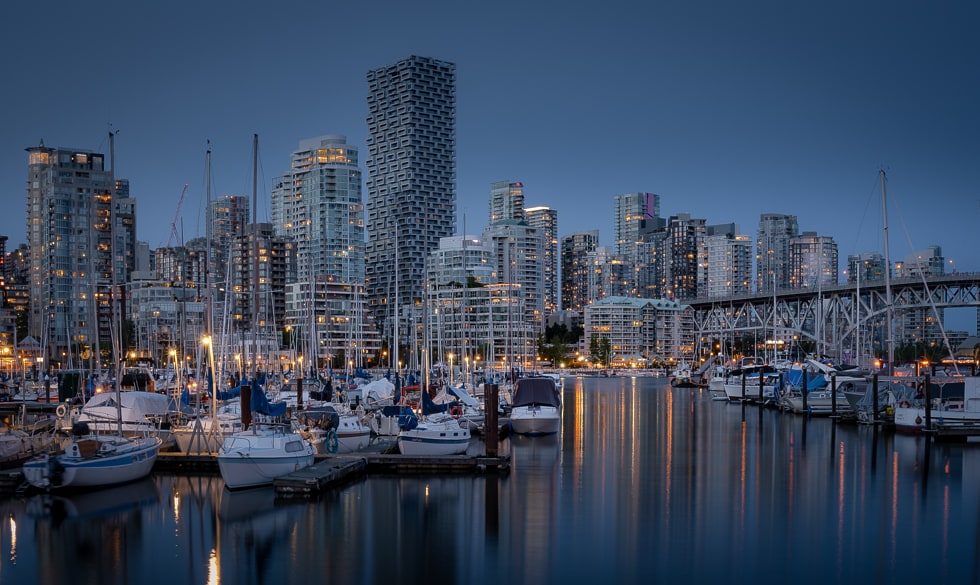
Of course, my new ultra-wide lens was almost always attached. Standing near a marina, it felt like the perfect choice. It comfortably included the boats, water and skyline in a single frame, easily capturing the type of photograph I’d imagined while planning the trip. At the time, there seemed little reason to change it.
We wandered through Gastown, listened to the famous Steam Clock announce the hour, explored the curiosities in Chinatown shops, and spent an afternoon around Granville Island watching people come and go from the busy market.
Downtown was busier than I’d expected. Beyond the polished waterfront were traffic-clogged streets, older buildings and the everyday realities of a large city. It was a useful reminder that even cities famous for their beauty are still lived-in places, full of contrasts and complexities.
The next morning we caught the ferry to Bowen Island, where the pace of life slowed almost instantly. We walked to tranquil Killarney Lake and spotted otters playing beside a small waterfall. We unpacked a simple picnic and spent the afternoon enjoying the sunshine before making our way back to the ferry along the coast, passing lakeside homes with enviable views.
Stopping to photograph one of them, a resident came outside simply to say hello. We chatted for a while before she disappeared back into the garden and returned with a homegrown cucumber for us to take on our journey. It was completely unexpected, quietly amusing, and another small example of the kindness we’d already experienced in Canada.
The cucumber ended up travelling with us all the way to Alberta.
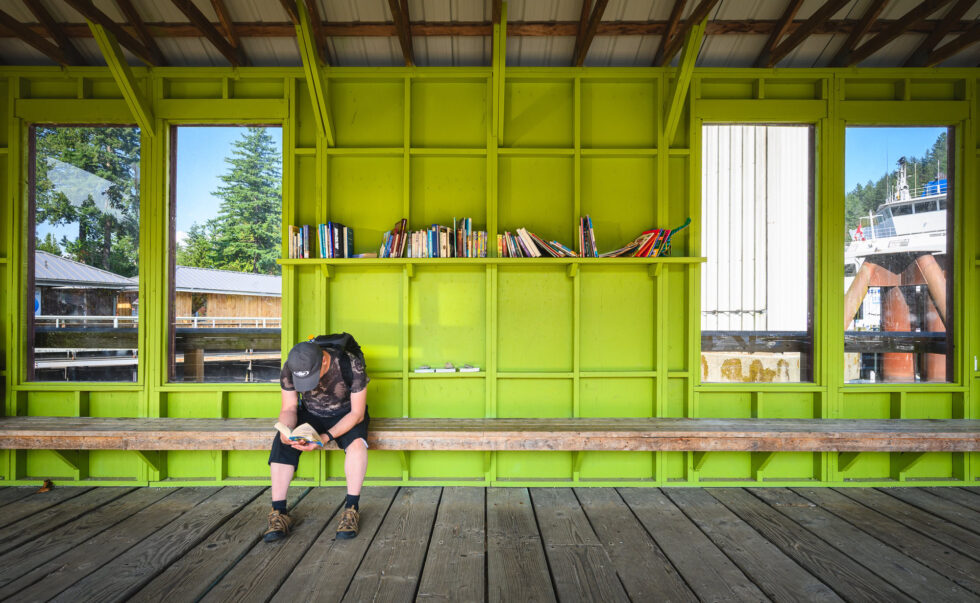
While waiting for the ferry back, we browsed through books that had been thoughtfully left at the port for travellers to enjoy. It felt like a different world from downtown Vancouver, despite being only a short ferry ride away.
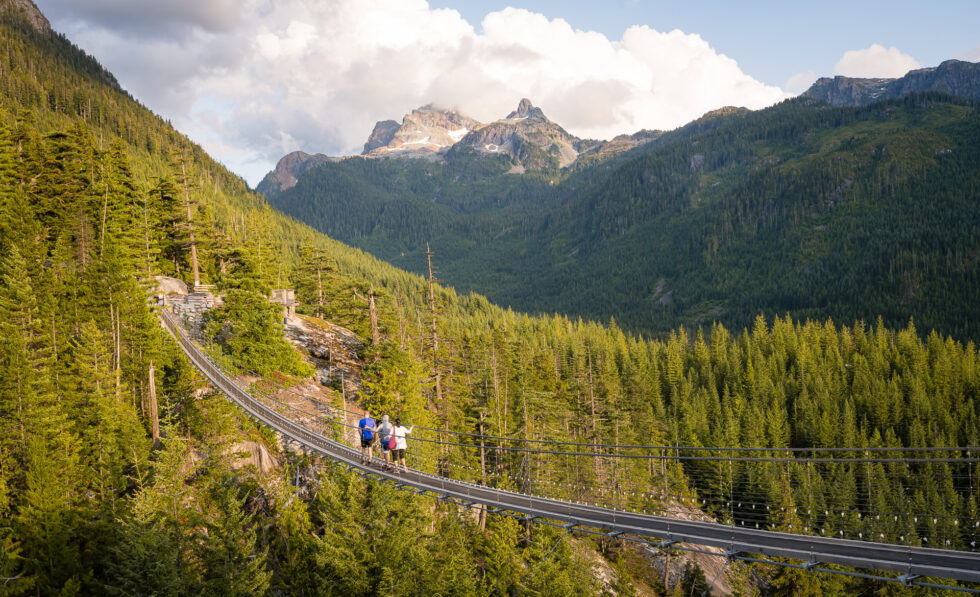
Back on the mainland, driving north towards Squamish, we took the Sea to Sky Gondola high into the mountains. It was my first real taste of the dramatic scenery I’d travelled all this way to see.
From the upper station, mountain ridges stretched away in every direction.
A live band happened to be playing outside the Sky Pilot Eatery, and as people danced with the mountains behind them, we sat with a drink simply taking everything in.
It was one of those moments no itinerary could have promised.
I’d reached that point in a trip where you start to relax. Where you feel part of a moment in time, rather than just observing it as an outsider. I remember thinking that if this was only the beginning of the journey, I could hardly imagine what the Rockies themselves would be like.
After what felt like too few days, it was time to leave Vancouver. We packed the car and pointed it east.
• • •
Trans-Canada Highway
Leaving the city behind and joining the Trans-Canada Highway felt like the real beginning of our road trip adventure. The road ahead promised waterfalls, glaciers and mountains on a scale I’d only ever seen in photographs.
Within a short time the city skyline had disappeared in the rear-view mirror. The roads seemed to stretch endlessly ahead, each bend revealing another landscape that would have justified stopping the car.
Sometimes we did.
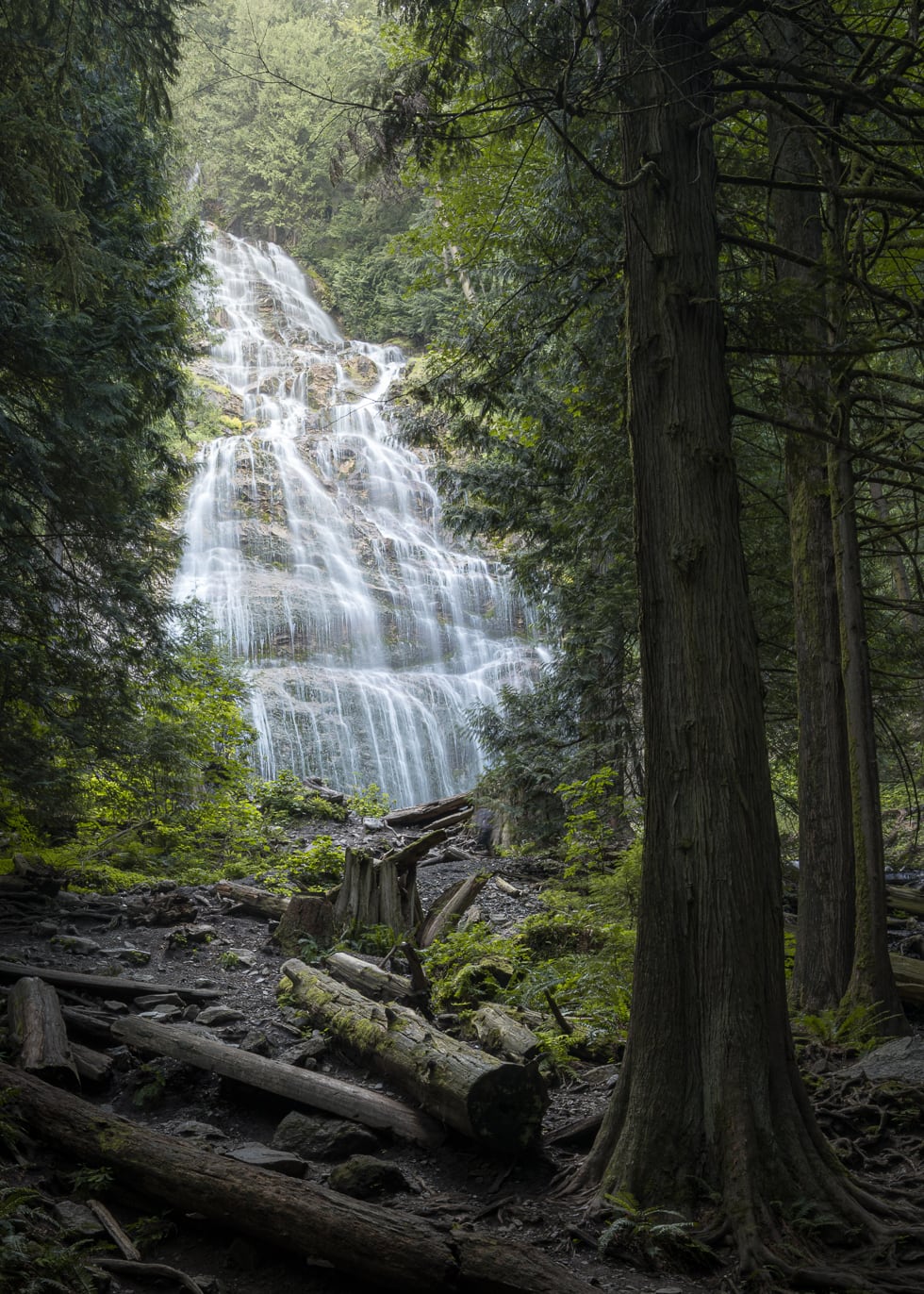
Our first memorable stop was Bridal Veil Falls, where a broad curtain of water spilled down a sheer rock face into lush woodland below. Standing at the viewing spot, I remember feeling completely absorbed by the scene. Towering trees and the powerful cascade worked together to create the sort of layered photograph I’d imagined when I bought the lens.
Even now, I believe it to be the most beautiful waterfall I’ve seen, and it hangs as a print on my dining room wall.
Over the following days, the landscape changed constantly. Small towns gave way to forests, long highways and, eventually, the Rockies themselves. With our carefully assembled playlist playing on the car’s stereo, we settled into the rhythm of the road.
Somewhere along the way we stopped at a classic car museum, posed for ridiculous photographs beside oversized sculptures of dinosaurs and bears, and broke up the journey with regular visits to roadside diners.
It was around this point that the distances really began to sink in.
Driving across western Canada isn’t quite the same as a road trip through Britain. Places that look comfortably close together on a map often turn out to be several hours apart, but that never felt like a problem. The journey itself became part of the adventure.
We bought the camping equipment that would become our portable home for much of the trip. Lodges and hotels around Banff and Jasper National Parks were far beyond what we wanted to spend, so camping became the way to experience the Rockies within our budget. But there was also something appealing about the idea of waking up surrounded by mountains, spending evenings beside a campfire and feeling immersed in the landscape from dawn until dusk.
Every morning we packed the tent, loaded the car, grabbed a coffee and set off towards another place whose name had lived in my imagination for years. The scenery never stopped surprising us. Forests gradually became mountain passes, rivers followed the roadside for miles, and every hour seemed to reveal another scene that made us wonder how it could possibly get any better.
As we climbed higher into the mountains, we passed through Glacier National Park, pausing whenever a waterfall or mountain view tempted us to get the camera out, before continuing deeper into the Rockies.
Only afterwards did I realise how much that rhythm shaped my photography. We were always moving towards the next destination, which meant we rarely spent long exploring any one location beyond the obvious viewpoints. Road trips have a wonderful sense of momentum, but they don’t always encourage the sort of slow observation that landscape photography often rewards.
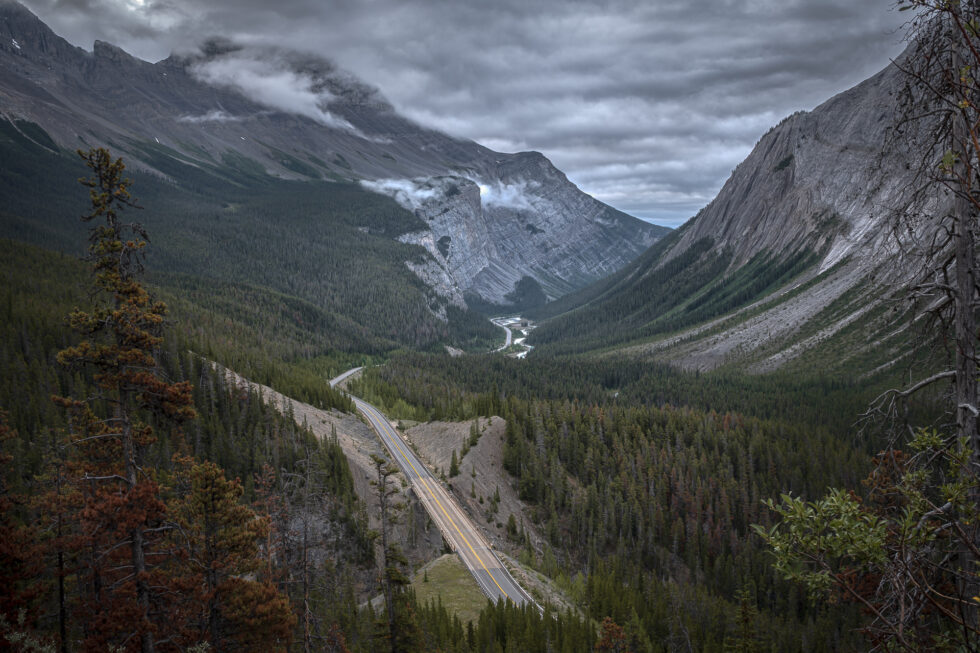
Driving along the Icefields Parkway felt almost surreal. Snow-covered peaks rose on every horizon while glaciers clung impossibly high to the mountainsides. Roadside cliffs rose up so dramatically that we had to pull over in lay-bys just to get out and take in the view. I remember thinking we should have hired a convertible. The scenery above us was just as spectacular as the road ahead.
I’d spent years looking at photographs of these mountains, wondering whether they could ever do them justice. Standing there in the Rockies, I realised the opposite was true. Every photograph I’d ever seen had made them seem smaller.
• • •
Jasper National Park
Jasper quickly became one of my favourite places on the entire journey. After days of moving from place to place, it was the first time since leaving Vancouver that we could stay for a few nights, settle into life at the campsite, and enjoy a brief break from packing up the tent every morning.
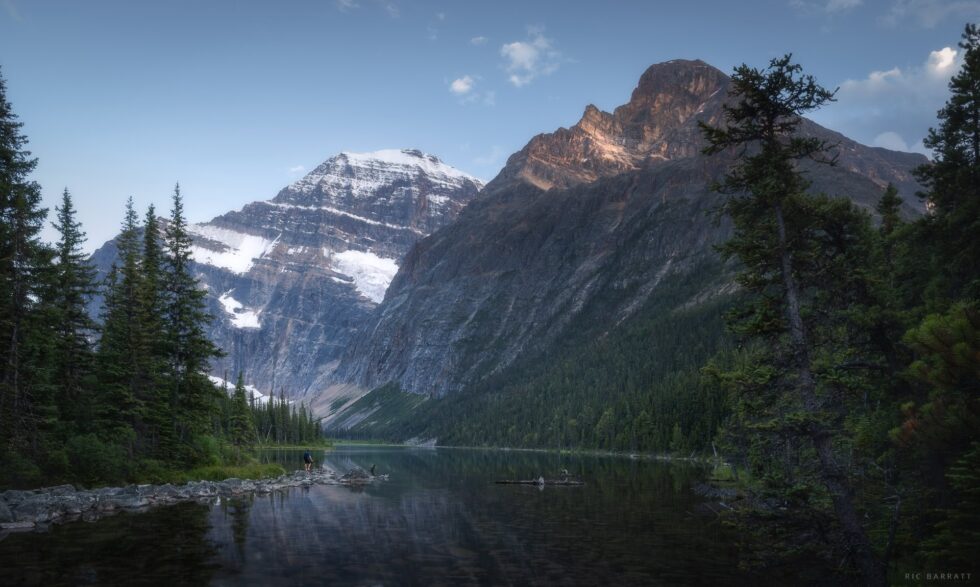
We explored Pyramid Lake, Mount Edith Cavell and Maligne Lake, rode the Jasper SkyTram high above the valley, and spent long evenings photographing waterfalls as the light softened towards sunset.
Athabasca Falls was particularly memorable. I spent far longer there than I’d planned, experimenting with different compositions while the roar of the water echoed through the canyon.
Wildlife soon became part of everyday life in Jasper.
Whenever we noticed a line of cars slowing unexpectedly ahead, there was usually only one explanation. The first time it happened, we had no clue what was going on, assuming there had been an accident. But after noticing people with cameras, we realised that wasn’t the case. We’d pull over, climb quietly from the car and look towards the trees, where a black bear might be wandering through the undergrowth, completely unconcerned by the small groups watching from a respectful distance.
Seeing bears from the safety of the car was one thing. Sleeping in a tent knowing they wandered through the surrounding forests felt rather different.
Eventually, though, everyday life catches up with every dream journey. We were half way through our holiday, and it was time to do some laundry.
One evening found us sitting in a basement laundrette in Jasper while our washing tumbled around the dryers, chatting with other travellers and locals. Those smaller moments make me smile just as much as the famous viewpoints. They were part of the rhythm of travelling, reminders that even dream trips are made up of everyday conversations and wonderfully ordinary afternoons.
• • •
Banff National Park
After several unforgettable days around Jasper, we continued south towards Banff.
It was a joy to drive the Icefields Parkway once more, this time in the opposite direction. Again we found ourselves pulling over simply to stand and look. Every so often the traffic disappeared completely, leaving us alone with the mountains and a silence that somehow made the landscape feel even bigger.
That sense of awe stayed with us as we approached our next national park, knowing that some of the most iconic landscapes of the Rockies still lay ahead.
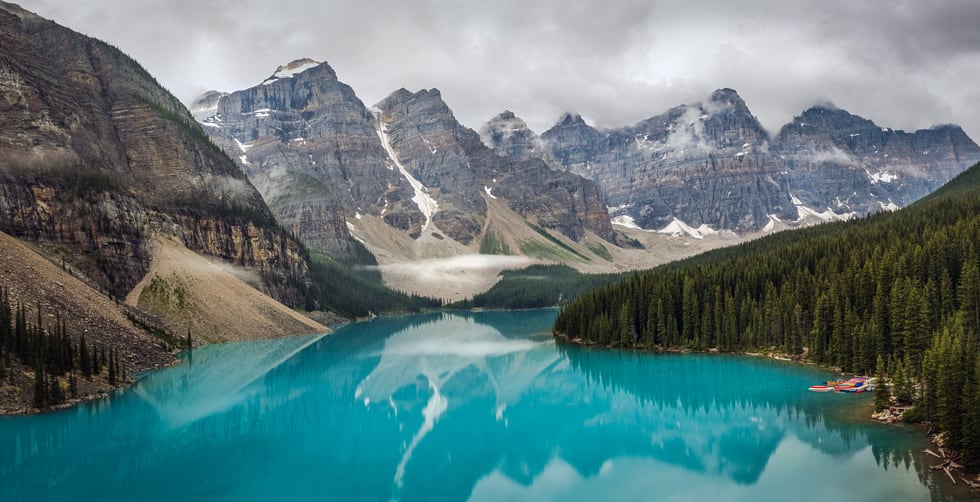
Like countless photographers before me, I’d seen photographs of Moraine Lake and its impossibly blue water for years. Arriving before sunrise, we managed to find a parking space before the crowds built up. Thick mist hung over the lake, hiding much of the landscape and leaving us wondering whether we’d made the early start for nothing.
Then, little by little, it began to lift.
The peaks gradually emerged from the cloud, and the scene I’d imagined for so many years slowly revealed itself. Despite the overcast skies, the lake was every bit as vividly turquoise as I’d hoped. It was wonderful to finally photograph it, but even better simply to be there.
The final few days passed almost too quickly. One day we’d spend the morning beside another mountain lake, the afternoon following a canyon trail or photographing waterfalls, then find ourselves in Banff as the evening light faded, wandering the streets with an ice cream or looking in shop windows before heading back to the campsite. It was an easy rhythm, and one I wasn’t quite ready to leave behind.
Before long, our time in the Rockies was drawing to a close. We packed up the tent for the final time, knowing there would never quite be enough time to see everything. We’d seen places I’d dreamed about for years, photographed landscapes that had once seemed impossibly distant, and created memories that would stay with us long after we left.
The reality of camping hadn’t quite matched the romantic picture I’d imagined. Evenings were often spent covered in insect repellent, and with no hot showers available at our final campsite, washing it off became a nightly ritual of its own. By the end, we were looking forward to a proper bed almost as much as a sunrise over another mountain lake.
The national parks we’d explored were everything I’d hoped they would be. Camping, perhaps, a little less so.
• • •
Calgary
Continuing east, the Rocky Mountains gradually gave way to the wide, open spaces of the Canadian Prairies. With a little extra time before reaching Calgary, we made one final detour into the Badlands, where hoodoos and deeply eroded valleys looked almost otherworldly. We stayed at a small farmhouse near Drumheller, grateful for the simple luxury of a hot shower, a comfortable bed and a cooked breakfast.
We spent a couple of days photographing nearby ghost towns, climbed the World’s Largest Dinosaur with the sort of enthusiasm that probably makes adults look slightly ridiculous, and visited the Royal Tyrrell Museum, whose extraordinary dinosaur collection became an unexpected highlight.
It reminded me that memorable journeys aren’t made entirely of postcard landscapes.
Eventually, we arrived in Calgary. If I’m honest, I’d thought of it mainly as somewhere to finish the road trip before flying home. I assumed the city would feel like the end of the adventure rather than part of it.
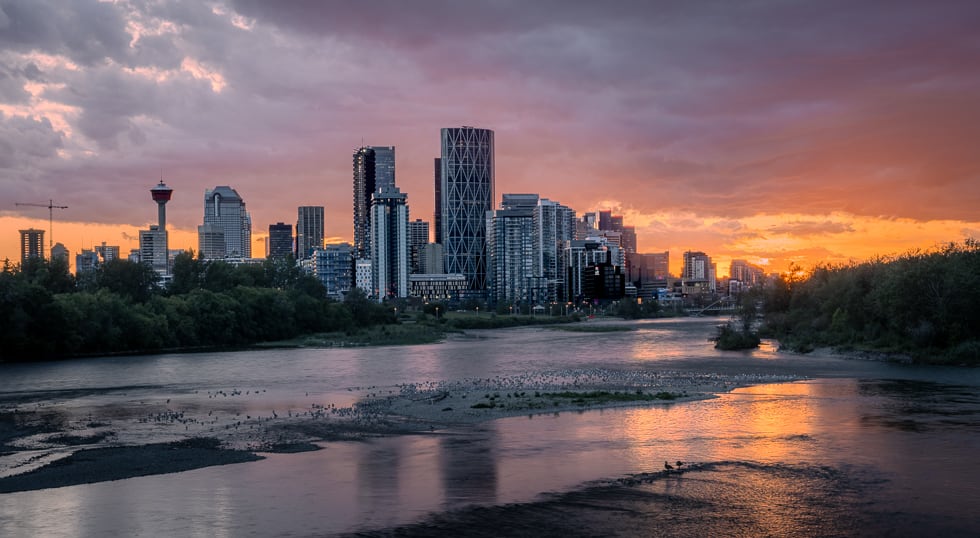
Instead, I found a city that deserved far more than just a final overnight stay. The Bow River winding through the city, the modern skyline and the views from the surrounding hills all made it wonderfully photogenic. Away from the dramatic peaks of the Rockies and the unusual rock spires of the Badlands, Calgary had its own sense of scale and beauty. The broad river valley and mixture of old and new architecture gave it a completely different character from Vancouver, yet I found myself reaching for the camera just as often. We spent time wandering the city, enjoying its parks and river views, and reflecting on everything we’d seen.
On our final evening in Canada, we found ourselves with an hour or two to spare before heading back to the hotel. Hoping to squeeze in a few last photographs, we made our way towards Tom Campbell’s Hill, thinking it might offer a good viewpoint for some night shots of the downtown skyline beneath the overcast sky.
Then, as we crossed the Bow River, something unexpected happened.
The sun suddenly broke beneath the cloud, setting the sky ablaze with shades of orange and purple that reflected across the water. We quickly found somewhere to park, hurried back onto the bridge, and managed to make a handful of photographs before the colours faded.
It felt as though Canada had saved one final surprise until the very end.
One of those photographs has become a favourite of mine.
Standing on that bridge, I found myself thinking back to my friend in the UK and the advice she’d given before we booked the trip.
“Bucket-list destinations aren’t supposed to stay on your bucket list forever. You’re supposed to go.”
She was right.
As we stood looking across the skyline, my travelling companion asked whether I still wanted to drive up the hill for those night photographs.
“No,” I said. “I think we’re done.”
• • •
My photographs of Canada remind me not only of the places themselves, but of the photographer I was at the time.
I don’t regret taking the ultra-wide lens. Many of those images remain among my favourites. What surprises me is how rarely I took it off. I hardly made any photographs that explored the mountains more closely or isolated the details that first caught my eye. If I’d thought to swap lenses more often, I might have returned home with a richer, more varied collection of images.
But the lens wasn’t the only thing that shaped my photographs. The pace of the journey did too.
It was wonderful to visit places like Moraine Lake and Athabasca Falls. They’re famous for good reason, and seeing them with my own eyes was genuinely unforgettable. But too often we drove from one iconic location to the next, ticking them off almost without realising it. We rarely had time to get to know a place.
Road trips have a wonderful freedom, but they also have a habit of encouraging you to keep moving. If I returned today, I’d choose fewer destinations and stay longer in each one. I’d spend more time wandering away from the main paths and allow myself to experience places rather than simply pass through them.
More than anything, I was learning that travelling through a landscape and truly experiencing it are not always the same thing.
If I ever return to western Canada—and I hope I do—I doubt my journey would look quite the same.
I’d probably take fewer photographs. Not because Canada deserves fewer images. Quite the opposite. It deserves more time.